
(http://www.royalcollege.ca/rcsite/health-policy/policy-positions/opioids-e)
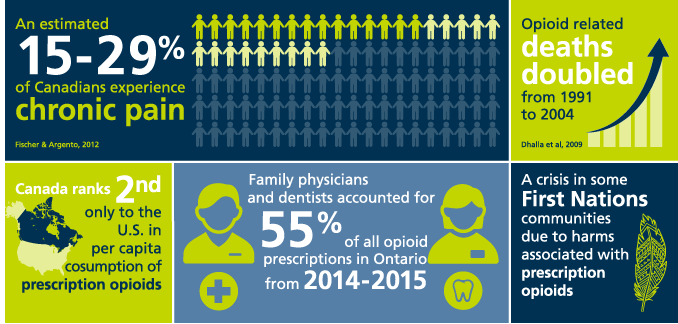
The Opioid Epidemic has been the ‘talk of the town’ in Calgary and across the world, individuals everywhere are sharing their opinions on what needs to be done – if anything at all. In a 9 month period (January-September 2017) there were 2923 Opioid related deaths nation wide, and 92% of those deaths were accidental (Government of Canada, National Report). 71% of Opioid related deaths occurred in individuals ages 30-59 (Government of Canada, National Report), this is greatly skewed by the media who positions drug users as individuals who are “at the bottom of the barrel,” and are just a “burden to society.” These views need to be challenged, and heard in order to identify the aspects of this epidemic that are difficult to grasp. Opioids are primarily used to treat pain, and occasionally moderate to severe coughs and moderate to severe diarrhea. (Government of Canada, About Opioids). Different variations of Opioids include codeine, fentanyl , morphine, Oxycontin and medical grade heroin (Government of Canada, About Opioids). Opioids are intended to be a prescription medicine, however prescription abuse and illegal manufacturing is common. Individuals often turn to Opioids found on the street once they stop receiving prescriptions from their health care provider. Specific concerns are situated with illegal heroin and fentanyl, and the possibility of overdoses, hepatitis C and HIV (Government of Canada, About Opioids). People who are abusing Opioids have an addiction and they need help, a life does not have to be lost due to some individuals inability to act due to a lack of education.
Recently, safe injection sites have been opening up across Canada, and the United States is following suit. The Sheldon M. Chumir Center in Calgary is an example of one of these sites, individuals can come to this location to safely consume illegal drugs. This clinic offers services such as testing for diseases, access to sterile needles, overdose intervention, and educational/referral services (Government of Canada, Supervised Consumption Sites Explained). This clinic caused a major uproar in Calgary when it was introduced back in 2017. I believe that in a democratic nation everyone needs to get on board with these efforts. The Sheldon Chumir has created such a divide among Calgarians, and that’s due to stigma and lack of education. People should be educated early on, in junior high and high schools about the serious dangers of prescription abuse. This needs to be done by facilitating discussions among stakeholders, by letting individuals voice their worries and concerns we can spark a conversation and remove the stigma around issues such as these. Additionally, individuals need to be educated on identifying the signs of an overdose, how to provide life saving measures, and laws surrounding this.
This video is a PSA that explains the Good Samaritans Law: https://www.canada.ca/en/health-canada/services/video/good-samaritan-law.html
From what I can gather from various conversations and debates the introduction of safe consumption sites has been the most controversial of all Municipal, Provincial and Federal actions taken to deal with the Opioid Epidemic. I believe that the high level of focus on these sites is strongly impeding the other actions being undertaken. Calgary’s Mayor addressed CBC News stating that, “the implementation of harm-reducing consumption sites must go hand in hand with three other pillars of the strategy — prevention, treatment and enforcement” (CBC News, Calgary’s 1st supervised drug site). I argue that there needs to be more conversations about the other initiatives being undertaken in order to educate and reduce stigma. These conversations need to take form in a calm and healthy environment – not in a debate format – individuals need to hear both view points. The media is filled with negative comments on these injection sites but does not explain how it fits in with other plans that have been put in place.
Federally, Canada has implemented the following four pillar approach (Government of Canada, Federal Approach on Canada’s Opioid Crisis);
- Prevention
- “Implement the Health Portfolio’s Problematic Prescription Drug Use Strategy”
- “Improve prescribing practices”
- “Better inform Canadians about the risks of opioids”
- Treatment
- “Better access for rural and remote First Nations communities”
- “Improve access to medication-assisted treatments for opioid use disorder”
- “Improve treatment options for pain management”
- “Share knowledge on treatments for opioid use disorder”
- “Increase cooperation between the criminal justice system and social services sector (like Drug Treatment Courts)”
- Harm Reduction
- “Support the establishment of supervised consumption sites
- “Facilitate access to naloxone”
- “Ensure timely laboratory drug analysis information is shared between partners”
- “Support legislation to protect individuals who seek emergency assistance for overdose”
- “Reduce public health consequences of problematic substance use”
- Enforcement
- “Continue enforcement on the importation, exportation and trafficking of illegal opioids”
- “Pursue legislative, regulatory, policy and programmatic changes to better control substances and equipment”
- “Collect, assess and share information with law enforcement agencies domestically and internationally”
- “Support education and training for law enforcement”
I purpose that more resources go towards educating people in our city about the larger plan at hand, I’m sure there are aspects of this plan certain individuals can support and others that they can not. The importance in facilitating these conversations is to provide individuals with a platform to have their thoughts voiced and to educate them on the harms of both prescribed and illegal Opioids. I believe Calgary’s Mayor summed it up perfectly when he said “It is not a crime to be addicted. Having an avenue to develop relationships with our vulnerable populations will help us find opportunities to get them the treatment they need to find their way out of addiction,” (CBC News, Calgary’s 1st supervised drug site). If someone would of explained the concept of a safe injection site to me a few year ago, I would of been strongly opposed and would have had no interest in learning more about the larger issue at hand. However, due to an event that took place in 2016 I found myself in the hospital in severe pain and was introduced to the ease and effectiveness of Opioids for pain management use. When I was placed on Oxycontin I did not question it, I had the belief that it was my best and only option. I remember the first dose I received, the pain went away and was replaced with a sense of euphoria. I was on Oxycontin for just over three weeks, when it came time to wean myself off I was terrified. The doctors created a plan for me, but I was terrified of ever being in that much pain again. I enlisted the help of my parents and boyfriend, I told them how scared I was and asked them to hold on to the medicine and administer it. I was ashamed and embarrassed, I knew I didn’t have the self control necessary to follow my treatment plan. Luckily for me, I had people to support me and give me the push that I needed, but the fact that after only three weeks I was so scared to stop taking the medication still scares me. My experience taught me that the stigmas about drug users are not entirely true, and that a large amount of people become addicted to Opioids through prescribed use. I remember asking my doctor why Opioids were the first and only pain management option I was given, he told me that it’s because its fast acting and there are not many other pain management techniques out there. My experience allowed me to view the Opioid crisis in a different light, the stigma is no longer there and I can relate to the fact that many users were introduced to Opioids through a medical provider. I am stubborn, and my views are not easily swayed. However, I believe that if my views could be changed through education then so could others. If we take the time to educate others and listen to their concerns we can take away the stigma, we can promote real and positive change and lessen the divide in our city.
CBC News (2017). Calgary’s 1st supervised drug use site to be at Sheldon Chumir centre. Retrieved October 19, 2018, from https://www.cbc.ca/news/canada/calgary/calgary-injection-consumption-site-sheldon-chumir-health-centre-payne-brandy-1.4160116
Government of Canada (2018). About Opioids. Retrieved October 19, 2018, from https://www.canada.ca/en/health-canada/services/substance-use/problematic-prescription-drug-use/opioids/about.html
Government of Canada (2018). Supervised Consumption Sites Explained. Retrieved October 19, 2018, from https://www.canada.ca/en/health-canada/services/substance-use/supervised-consumption-sites/explained.html
Government of Canada (2018). Federal Approach on Canada’s Opioid Crisis. Retrieved October 20, 2018, from https://www.canada.ca/en/health-canada/services/publications/healthy-living/federal-approach-canada-opioids-crisis.html
Government of Canada (2018). National Report: Apparent Opioid Related Deaths in Canada. Retrieved October 18, 2018, from https://www.canada.ca/en/public-health/services/publications/healthy-living/national-report-apparent-opioid-related-deaths-released-march-2018.html
 Social Innovation